Friday, 24 July 2009

Fender Standard Stratocaster Pickguard - Black Pearl - For 2 Humbucking and 1 Single-Coil Pickups

Guitar Replacement Pickguard. Made by Fender.

One of the really nice things about Fender instruments is that you can change the look of your instrument with relative ease.

One of the easiest ways to accomplish this is to replace the pickguard! Fender offers a variety of pickguards with different pickup configurations and materials to help you add a personal touch to your favorite Fender instrument. This 4-Ply, 11 Hole Pickguard, is for 2-Humbucking and 1 single coil pickups.

Fits:

  • American, American Standard, Hot Rod and Deluxe Series Stratocasters, (also Big Apple / Double Fat Strat) (USA)
  • Standard, Deluxe and '70s Stratocasters (Mexico)


In the current world of investing for the future, one sure way to beat inflation and devaluation of the bond market is to put your money in vintage electric guitars. The demand for original flying v or Paul McCartney left handed guitars continues to rise in spite of recessions.

Especially in demand are vintage Gibson hollow-body, Fender's vintage sunburst Stratocaster and vintage Fender guitar amplifiers. Nostalgia for early rock is only one reason for the high valuation of vintage guitars and accompanying guitar equipment. The main reason demand is so high for vintage guitars is the sound they produce is as unique as the instrument itself.

Decades ago, when vintage guitars were new, the technology to produce them was in its early stages and many of the electric pick-ups had to be hand-wound or if they were machine made, each was just a little different. A few less strands of wire in the pick-ups caused a little different sound. The bodies were not completely uniform either, making the sound-box on each just a little different from the next guitar being made. As a result, each guitar was just a little unique. Additionally, over time, the electronics degraded a little causing even more difference and variation from instrument to instrument.

Original Fender guitar amplifiers were made with tubes and not with current "solid-state" circuitry. Tubed amps, like Fender and Epiphone vintage amplifiers had unique sounds which cannot be made with the cleaner Marshall or Yamaha solid-state amplifiers on the market today. Those with good ears can tell a guitarist playing vintage guitars and on vintage amplifiers.

When buying a vintage guitar or vintage amplifier, look for low Fender serial numbers on the back of the body. Review serial number ranges from web-sites of Fender, Epiphone, Gibson, Jackson, and Yamaha to find when the vintage guitar you are considering was made. Knowing as much about your investment will assure its continued increase in value.
Vintage Guitars as an Investment

One sure way to beat inflation and present devaluation of the bond market to invest for the future is to put your money in vintage electric guitars. Paul McCartney left handed guitars and original flying v guitars will have demand in spite of recessions.

Vintage Gibson hollow-body, Fender's vintage sunburst Stratocaster and vintage Fender guitar amplifiers are especially in demand. The high valuation of vintage guitars and accompanying guitar equipment is not just driven by nostalgia for early rock. The unique sound produced by vintage guitars is the main reason demand is so high for older guitars.

Each guitar was just a little bit different when these vintage guitars were made decades ago and the technology to produce them was in its early stages. Many of the electric pick-ups were hand-wound, or if they were machine-made, just a little different from the next. If the pick-ups had a few less strands of wire, the sound would be just a little different. Sound boxes as part of the bodies were not made exactly uniform either, making the guitars sound just a little different from same product lines making each guitar just a little unique. Finally, the electronics degraded over time causing each instrument to be a little different from the next.

Marshall and Yamaha solid-state amplifiers on the market today are cleaner, unlike original Fender guitar amplifiers which were made with tubes. Fender and Epiphone tubed vintage amplifiers had tonal qualities that are prized because they are not "clean", but sound unique. Guitarists playing vintage guitars and vintage amplifiers can be identified by those with good ears.

Look for low Fender serial numbers on the back of the body when buying a vintage guitar or vintage amplifier. Web-sites of Fender, Epiphone, Gibson, Jackson Guitars and Yamaha vintage guitars will guide you to when a specific vintage serial number occurred which will help you in your purchase as to when it was made and possibly for whom. In order to be sure your investment will continue to increase in value, know as much as possible before making the decision to buy a vintage electric guitar.

In these uncertain times invest and have a ton of fun to boot. Vintage Gibson guitars are an excellent way to beat that hedge. Not only is it profitable but also fun to own commemorative and rare electric guitars.

See our complete selection of vintage electric guitars as well as our other guitars at Vintage Electric Guitars

fender 40th anniversary stratocaster
Wednesday, 22 July 2009

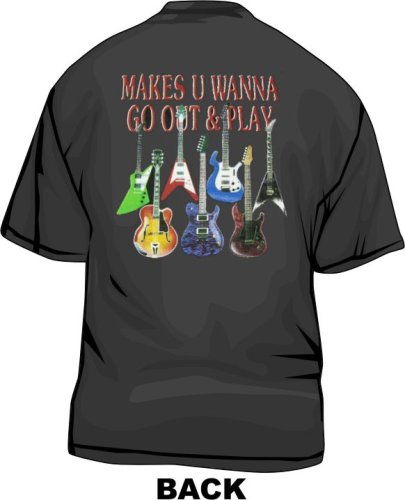
Makes You Wanna Play Multi Guitars Men's tee Shirt in 12 colors Small thru 6XL


If you've been hearing the buzz on Urge recently, it's not about a deep desire or compulsion - it's about MTV's offering to the world of online music downloads and streaming.

Urge is a subscription based music download service in which its patrons can subscribe for a monthly fee of $10 and listen to as many of the 2 million songs in MTV's coffers as they like. If they'd like to download that song, then it costs 99 cents each.

But it's not just MTV behind the latest addition to the world of online music. Microsoft and MTV are working together on this one. Bill Gates must have seen the success of similar sites like Napster and Rhapsody and decided to jump on the bandwagon. Urge's challenge will be to convince all those music lovers who prefer to buy songs and download them through sites like the incredibly popular iTunes, owned by Apple computers, that subscribing to a site and being able to listen to whatever songs you like, in whatever order and as often as you like is just as good or better than buying them one by one. It's just one more battle to add to the long running conflict between Microsoft and Apple.

Does Bill have anything different to offer through Urge? Anything that makes this latest venture stand out from similar sites? Not really. Should you choose to become an Urge subscriber, you won't find any music that you wouldn't find on any other download - subscription site. The prices are even pretty much the same.

What they do offer is a aesthetics - their site looks good. Plus, there's the camaraderie. Subscribers can post on blogs and converse with one another. But that's about it.

But with Microsoft powering the marketing and advertising engine behind Urge, it's sure to do well. Even the latest incarnation of Microsoft's Windows Media Player has Urge built in. Everyone with a PC has access to this free player and therefore easy access to Urge.

What PC users won't have is the portability provided by the wildly popular iPod. Current owners of iPods, should they decide to subscribe to Urge, will have to buy songs through the site, download them, burn them onto CDs and then convert the music files to mp3s in order to be compatible. Other portable devices are compatible with the service, however, and those are listed on the site.

This all may change in the Christmas of 2006, as buzz indicates Microsoft plans to release their "iPod Killer". Based on the Xbox brand, and including additional features like gaming, this media player is aimed right at Apple's heart, and could quickly make "Urge" a household name, assuming the two products are closely linked.

Each of the music download sites has their own strengths and weaknesses. Urge fully divides and subdivides genres so that its subscribers can easily find what they're looking for while exploring other bands that they might like. Yahoo Music Unlimited personalizes the start page to include suggestions based on the subscribers previous downloads and offers a cheaper subscription rate. Rhapsody has the best radio services, providing specialized stations that stream a pre-set list of music.

If you can't decide, then try one or try them all. Each of them offers a free trial subscription. You can experiment with all of them and decide which one suits you best.

Madison Lockwood is a customer relations associate for ApolloHosting.com. She brings years of experience as a small business consultant to helping prospective clients understand the ways in which a website may benefit them both personally and professionally. Apollo Hosting provides website hosting, ecommerce hosting, vps hosting, and web design services to a wide range of customers. Established in 1999, Apollo prides itself on the highest levels of customer support.

fender stratocaster hss

Thursday, 16 July 2009

Fender Standard Stratocaster Guitar 3-Ply Back Plate White

Guitar Replacement Backplate. Made by Fender.

Fender offers an assortment of Stratocaster back plates for all of your replacement needs.

This back plate is 3-Ply and comes in a white finish.


Ever since the guitar turned electric in 1931 rock stars have been twisting, bending and distorting the traditional sounds of the guitar to create unique master pieces that remain legendary. Rock and roll would never be if it weren't for the electric guitar. The first electric guitar was made in 1931 by the Rickenbacker company and has seen little change of the basic concepts other than the addition of solid state electronics.

Tons of different electric guitars have been introduced from countless guitar companies, but there remains a top few that have been used again and again since rock and roll arrived in the early 1950s. Below are the top 10 electric guitars of the past 50 or so years tha have became legandary.

10. BC Rich Warlock - An incredibly unusual shape introduced in the 1970s looks and sounds like its name. B.C Rich was a top choice and popularized by heavy metal bands in the 1980s like Megadeth, Danzig, Warrant and Poison just to name a few.

9. Gibson SG - The SG (solid guitar) created in 1961 was popularized by the Australian based heavy metal band, AC/DC and Angus Young's top electric guitar for sure.

8. Gibson Explorer - The airplane-looking shape was also a top favorite for heavy metal guitarists. The shape was so popular that it spawned numerous custom cloned from companies such as ESP. James Hetfield of Metallica was regularly on display with this top guitar.

7. Danelectro - One of the most simple, yet flashy designs, the Danelectro was pretty and sported a cylindrical pick-up nicknamed the "lipstick." Jimmy Page of Led Zeppelin fame made this his top choice in the last few years of the band's existence.

6. Gibson SG Doubleneck - One of the strangest looking guitars, but one of the most versitile. What was tops about this guitar was that the top guitar was a twelve string and the bottom a six. This allowed for cool variations in tone and feel without the need of switching guitars during a song.

5.Gibson Flying- V - A top rock guitar for musicians who want to make a statement. Though awkward to play in a sitting position (arguable because you can't rock out sitting down), this guitar was actually a favorite of Jimi Hendrix.

4. Rickenbacker 425, 360/12 - There is no mistaking the sound of a Rickenbacker because of is resonating tone of the 12 strings. Made famous in rock and roll by George Harrison and John Lennon, this later became a top pick for bands finding a more melodic yet harmonic electric tone. Since then, bands ranging from the Byrds to R.E.M. also consider this a top pick and a staple of their unique sound.

3.Fender Telecaster - Another uniquely toned guitar made famous by Jimmy Page, this interesting single-coil pickup sound machine also sported a special "bending" device hooked to the top string that can be manipulated by pulling down on the guitar strap.

2. Fender Stratocaster - You cannot mistake the hollow, yet clear and bright sound of a Fender Stratocaster. It is amazing that a guitar this old has remained unchanged and yet still delivers the same power that Jimi Hendrix and Eric Clapton made famous back in the 60s. This is arguably the top choice of all Chicago-style blues players.

1. Gibson Les Paul Standard - Sexy, standard and unchanged, this top pick delivers the power and punch that has been heard by the top rock and roll bands in history. Sporting dual humbucker pickups, this guitar's sounds is like that of a 1960's muscle car. From metal, to hard rock, to punk and funk, the Les Paul Standard is arguably the most popular electric guitar in history.

Although it is nearly impossible to list these top electric guitars in any order, one can safely say that purchasing and playing any guitar on this list will certainly put a smile on your face and at the same time, conjr up fantasies of being on stage with your favorite bands. TonyRocks.com has continued this list but also reviews a number of newer guitars that didn't make it to this top list. Plus you'll be amazed at some of the guitar shreding videos posted by Paul Gilbert, famous for his Ibanez.

Want to learn more about rocking out and picking the right electric guitar for you? Visit http://learnplayguitar.tonyrocks.com and discover what it takes to shred like your favorite guitarists.

aluminium fender stratocaster

Friday, 10 July 2009

Stratocaster Greats: Playing in the Style of Fender


The Gibson Firebird was made from 1963-65 in the initial reverse body shape, and from 1965-69 in the non-reverse shape. The two models were later reissued and are still on sale. Gibson had been accused of being overly conservative in the 1950s, only marketing the Les Paul solid-body electric guitar and its various semi-acoustic guitars such as the ES series. This meant that, to the younger market Gibson were at a disadvantage to Fender's more modern designs, the Stratocaster and Telecaster. As a riposte to all the people who claimed Gibson were being too conservative, the company released the Explorer and Flying V models in 1958 as part of an angular three-guitar "Modernistic series", along with a third guitar, the Moderne, of which none were ever built until the model was "reissued" in 1982. The three modernistic guitars were very unsuccessful. In the original 1958 series of guitars, no Modernes were built, (although some eager collectors are still waiting for a 1958 Moderne to surface), and less than 150 Flying Vs and Explorers were built in total. The Modernistic series was discontinued in 1959, having been a complete failure.

Gibson decided in 1963 that they needed another foray into more modern styles of guitars, although they were careful to avoid another failure like the Modernistic series had been. They enlisted the help of Ray Dietrich, an American car designer. Dietrich decided to use the Explorer model as a base and came up with what would become the Firebird shape, basically an Explorer with rounder edges and a softer shape overall.

Gibson released the Firebird in "reverse-body" format in mid-1963. It was much more successful than the Modernistic series was, although 1960s guitarists still found the shape too radical for their tastes. It was decided in 1965 that the bold Explorer-esque shape was to blame. Gibson designers put the body on the other way around, and the more conventional "non-reverse" body style was born. This was sold from 1965 to 1969, when the Firebird was discontinued altogether.

In 1972 the "reverse" Firebird was reissued. The "non-reverse" body was not reissued, although it was added as a Gibson Custom Shop guitar in 2002.

In the Firebird's original range there were four models, all unusually named using Roman numerals. The Firebird I had one humbucker pickup and chrome hardware. The Firebird III had two humbuckers, a Gibson Vibrola tailpiece and chrome hardware. The Firebird V was the same as the III, but with a Tune-O-Matic bridge. The Firebird VII had three humbuckers, a Vibrola tailpiece, a Tune-O-Matic bridge and gold hardware. Later the Firebird XII was added to the range. It was a "non-reverse" shape with 12 strings and two pickups. The pickup options were Gibson's old-fashioned P-90 singlecoil, humbuckers, or mini-humbuckers.

The "reverse" Firebird is noted for its' radical shape and the fact that the tuners are on the back of the headstock, hidden from view. The more conventional "non-reverse" shape eschewed both of these traits.

Famous Firebird players include Eric Clapton, Dave Grohl of the Foo Fighters, Johnny Winter and Brian Jones, original lead guitarist for the Rolling Stones. Allen Collins of Lynyrd Skynyrd also used a 1964 Firebird to record the famous solo in Free Bird.

Mark Flys is webmaster for the online guitar guide. The online resource for all guitar and bass information, online lessons, tabs and cheap instruments. http://www.onlineguitarguide.co.uk

fender 50th anniversary stratocaster

Tuesday, 7 July 2009

Stevie Ray and his Fender Stratocaster Decorative Art Photographic Poster Print by Rhonda Watson, 20x16

AllPosters.com is the world's #1 seller of posters, prints, photographs, specialty products and framed art. We're dedicated to bringing our customers the best selection of high quality wall décor that is perfect for their home or office. Browse our catalog of over 300,000 items that include entertainment and specialty posters, decorative prints, and art reproductions. Whether you're looking for your favorite movie or music poster, a framed Monet reproduction, or a print of the Eiffel Tower you will find it at AllPosters.com. Visit our Amazon store today at www.amazon.com/allposters to find Special Offers and search by subject category or artist. AllPosters.com provides unmatched service with a 100% satisfaction guarantee. We ship internationally to over 80 countries. Decorate your home today with your favorite pictures.


Have a child in piano lessons who wants to compose their own songs, but is having trouble getting started. Does he or she try to make up their own melodies on the piano? Piano Students often think they have to be Beethoven or Mozart to compose their own pieces. It's not true. Here are five tips to help piano students begin to compose their own songs. Share it with your piano student at home. Or maybe you'd like to try your own hand at composition.

1. I can't think of a tune or anything to write lyrics about.

Every piano student has a source of song. You just have to know where to look for it. I recommend that students who want to compose their own music keep a "Piano Memory Box." This is a special place to store keep sakes and mementos of special personal experiences they want to remember in the future. I made one of these for my son when he was a young piano student and he still uses it as a senior in High School. When he was little I suggest he put things in it like photographs of special memories, a ball of cotton dipped in his grandmother's perfume, a little jar of dirt from a special vacation spot we liked to visit, or the school paper he wrote on "What I Did This Summer." Over the years he has put lots of things in this little box. Recently, I happen to notice him throw in some ticket stubs to a move he saw with his girl friend. As he grows into a man I hope he'll remember to take a look back inside this little box whenever he's looking for a source of song or inspiration, and remember who he is. Oh, there will be some sad memories there as well, but this too is the stuff song writers are made of. Just look back at your own history of experiences to compose a song that is meaningful to you.

2. I don't know how to get started.

Songs are just poetry put to music. Start by writing a poem. Once you have your poem, white another short statement that summarizes your message. Use this as your chorus. If students can manage to do this in English Class they can do it in piano.

3. I don't hear any music in my head.

To hear some music in your head, start singing your poem or playing it on the piano. Think of the tone and spirit of your poem. Is it funny, or beautiful, or stormy? Then start creating your melody by asking a question. Then respond to it by giving an answer. This is referred to as a call and a response. The "Call" sounds unfinished, and the "Response" completes the musical idea. This will be your first verse.

4. I can't figure out how to put the music together so it flows.

Take your first verse and call it A. Then create another call and response for your chorus. We'll call this B. Write as many verses as you want to. Here is a simple option for putting your song together. A/B/A

Here's an example to show you how easy this is.

A: Verse Call - Twinkle, twinkle, little star

Response -How I wonder what you are.

B: Chorus

Call - Up above the world so high,

Response - Like a diamond in the sky.

A: Repeat Verse

5. I still can't think of a melody for my poem.

If you still can't come up with a melody, try this. Create a variation on the simple melody above. This will help you begin to hear and understand how melodies are created, using the call and response technique. To hear more complex variations on this childhood melody, find a piano CD with some of the many variations on this theme composed by Mozart.

To learn the best way to share the gift of music with children visit Amazon.com for my Piano Bears Musical Stories for Children The exciting Piano Bears Musical Stories for children ages 5 to 11 feature the loveable characters, Mrs. Treble Beary and her new piano student, Albeart Littlebud. Children love following along with Albeart to Mrs. Treble Beary's piano studio in Musical Acres Forest. Here they learn what piano lessons are all about in a fun way that kids readily understand and appreciate! Piano students laugh and giggle while reading "Little Bear's Musical Garden" and "Little Bear's Piano Goals."

For a wealth of f'ree information and piano music online visit Piano Bears Music Education Resources Don't Wait to Share the Gift of Music!

counterfeit guitars fender stratocast