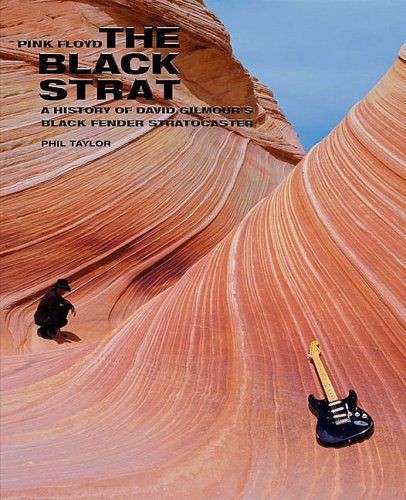
 The Black Strat book is the first and only accurate and knowledgeable account of David Gilmour's favorite Stratocaster guitar. Written by Phil Taylor - David's personal guitar technician since 1974 - to coincide with the release of the long awaited and much requested Fender 'David Gilmour Signature Strat': an instrument replicating the look, set-up, sound and feel of David's famous black guitar as it is today. The chronological story begins with David Gilmour joining Pink Floyd in early 1968, his guitar at that time, his subsequent instruments leading to the purchase of the Black Strat in 1970, and the other guitars that have come and gone. The book details all of the changes and modifications made to the Black Strat, its use on Pink Floyd tours and iconic albums, David's solo projects, and various guest appearances throughout the years.
Customer Review: Pink Floyd: The Black Strat A history of David Gilmour's Black Fender Stratocaster
After reading this book in one sitting, it became an inspiration for me to build my own Gilmour black strat. It is a must for any fan of Pink Floyd as well as David Gilmour fan. A very detailed history of the guitar and it's owner and the various changes the guitar went through 'til it reached its current state. A wealth of pictures as well as info, so much as i said that i built my own gilmour strat. The only changes i made were in the neck, it is a C-shaped but a bit smaller to fit my hand, i did put a duncan ssl5 in the bridge, but instead of the fat 50's in the neck and 69 in the middle, i put 2 duncan ssl-3 in the neck and middle but the middle pickup is reverse wound, and instead of drilling a hole in the pickguard for the extra switch to turn on the neck pickup, i used a push-pull pot on the lower tone control to add the neck pickup. I decided to do the N.O.S version instead of the relic'd version. See if this book had that kind of inspiration for me, imagine what it may do for you. Go out and get it, enjoy yourself reading it, even if you don't build guitars.
Customer Review: David Gilmour's Black Strat-GRN
I, at first, scoffed at this story of David Gilmour's Black Strat; however, the more I thought about it, the more I believed that it would offer something of a storied journey. This proved to be a good historical read and journey of not only David and Phil Taylor, Daivid's Guitar Technician, but also of the journey of the Black Strat and several other Floydian Guitars. I am glad that I purchased and read this account.
When recording, mixing down, and mastering, we always come across those 3 different EQ options. Many ask, what is the difference between them and which one should I use. here is a little information to help you get started.
The one most of you will be familiar with is the Graphic EQ as shown in the example below. The faders are arranged from low to high frequency. The are set to a specific frequency. The graphic EQ is most often used to control feedback or to get the sound you want out of an instrument. In a recording environment, once the feedback is taken out of the room, the settings usually stay put.
Parametric EQ you will find to be very different from the Graphic EQ. They permit you to choose exactly which frequency you want via the Frequency setting and the Q control. A wide Q will center your frequency around a broad group of frequencies which will all be affected. It is a very broad adjustment. A narrow Q will only affect the frequencies within the narrow Q.
You can also set the Q to affect one sole frequency. This works well if you have a single frequency affecting your mix. You can easily isolate it and adjust accordingly. Software such as Cakewalk Sonar 6 Producer comes equipped with its own internal software version of all the varying types of EQ's in this article.
Paragraphic EQ is similar to the parametric EQ in that you can chunk out areas of frequency, but it does not give you the Q. It is a nice medium between a Graphics EQ and a Parametric EQ. It is very applicable for live sound, but we are seeing more and more studios putting the Paragraphic EQ to work.
I hope this helps to understand the differences, similarities and applications of these different types of available EQs.
Tinamarie Hite(Dae) is a musician and a sound engineer. She has over 20 years experience in the music business. Her experience covers a wide range of subjects from jazz theory to recording to the know hows of booking, gigging and live stage setup. She is currently working on several music projects. These include singer/songwriter productions, The Acoustic Duo, Cd recording, and a new band. Putting her experience to work comes naturally.
More informative articles can be found at http://www.musicxspot.com
counterfeit guitars fender stratocast