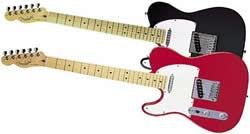
 Electric Guitar. Made by Fender.
No other guitar can match it -- the Fender Stratocaster is where the great guitar tradition began and still carries on today!
Featuring a fast-action maple neck, comfort-contoured body, three single-coil pickups and standard synchronized tremolo, the Fender Standard Strat is the guitarist's guitar! Pick one up and you hold the whole history of rock and roll in your hands...
Features
- BODY Alder
- NECK Maple, Modern "C" Shape, (Satin Polyurethane Finish)
- MACHINE HEADS Fender/Ping Standard Cast/Sealed Tuning Machines
- FINGERBOARD Maple, 9.5" Radius (241 mm)
- NO. OF FRETS 21 Medium Jumbo Vintage Style Frets
- PICKUPS 3 Standard Single-Coil Strat Pickups (Ceramic Magnets)
- CONTROLS Master Volume, Tone 1. (Neck Pickup), Tone 2. (Middle Pickup)
- BRIDGE Vintage Style Synchronized Tremolo
- PICKUP SWITCHING 5-Position Blade: Position 1. Bridge Pickup, Position 2. Bridge and Middle Pickup, Position 3. Middle Pickup, Position 4. Middle and Neck Pickup, Position 5. Neck Pickup
- HARDWARE Chrome
- STRINGS Fender Super Bullet 3250L, Nickel Plated Steel, (.009 to .042)
- PICKGUARD 3-Ply White
- SCALE LENGTH 25.5" (648 mm)
- WIDTH AT NUT 1.650" (42 mm)
- UNIQUE FEATURES Vintage Styling
- ACCESSORIES Includes Fender Gig Bag
NOTE: The picture on this page shows a gutiar with a Rosewood neck, if you order from this page you will receive this same model guitar with a Maple neck
The Gibson Firebird was made from 1963-65 in the initial reverse body shape, and from 1965-69 in the non-reverse shape. The two models were later reissued and are still on sale. Gibson had been accused of being overly conservative in the 1950s, only marketing the Les Paul solid-body electric guitar and its various semi-acoustic guitars such as the ES series. This meant that, to the younger market Gibson were at a disadvantage to Fender's more modern designs, the Stratocaster and Telecaster. As a riposte to all the people who claimed Gibson were being too conservative, the company released the Explorer and Flying V models in 1958 as part of an angular three-guitar "Modernistic series", along with a third guitar, the Moderne, of which none were ever built until the model was "reissued" in 1982. The three modernistic guitars were very unsuccessful. In the original 1958 series of guitars, no Modernes were built, (although some eager collectors are still waiting for a 1958 Moderne to surface), and less than 150 Flying Vs and Explorers were built in total. The Modernistic series was discontinued in 1959, having been a complete failure.
Gibson decided in 1963 that they needed another foray into more modern styles of guitars, although they were careful to avoid another failure like the Modernistic series had been. They enlisted the help of Ray Dietrich, an American car designer. Dietrich decided to use the Explorer model as a base and came up with what would become the Firebird shape, basically an Explorer with rounder edges and a softer shape overall.
Gibson released the Firebird in "reverse-body" format in mid-1963. It was much more successful than the Modernistic series was, although 1960s guitarists still found the shape too radical for their tastes. It was decided in 1965 that the bold Explorer-esque shape was to blame. Gibson designers put the body on the other way around, and the more conventional "non-reverse" body style was born. This was sold from 1965 to 1969, when the Firebird was discontinued altogether.
In 1972 the "reverse" Firebird was reissued. The "non-reverse" body was not reissued, although it was added as a Gibson Custom Shop guitar in 2002.
In the Firebird's original range there were four models, all unusually named using Roman numerals. The Firebird I had one humbucker pickup and chrome hardware. The Firebird III had two humbuckers, a Gibson Vibrola tailpiece and chrome hardware. The Firebird V was the same as the III, but with a Tune-O-Matic bridge. The Firebird VII had three humbuckers, a Vibrola tailpiece, a Tune-O-Matic bridge and gold hardware. Later the Firebird XII was added to the range. It was a "non-reverse" shape with 12 strings and two pickups. The pickup options were Gibson's old-fashioned P-90 singlecoil, humbuckers, or mini-humbuckers.
The "reverse" Firebird is noted for its' radical shape and the fact that the tuners are on the back of the headstock, hidden from view. The more conventional "non-reverse" shape eschewed both of these traits.
Famous Firebird players include Eric Clapton, Dave Grohl of the Foo Fighters, Johnny Winter and Brian Jones, original lead guitarist for the Rolling Stones. Allen Collins of Lynyrd Skynyrd also used a 1964 Firebird to record the famous solo in Free Bird.
Mark Flys is webmaster for the online guitar guide. The online resource for all guitar and bass information, online lessons, tabs and cheap instruments. http://www.onlineguitarguide.co.uk
john mayer fender stratocaster